
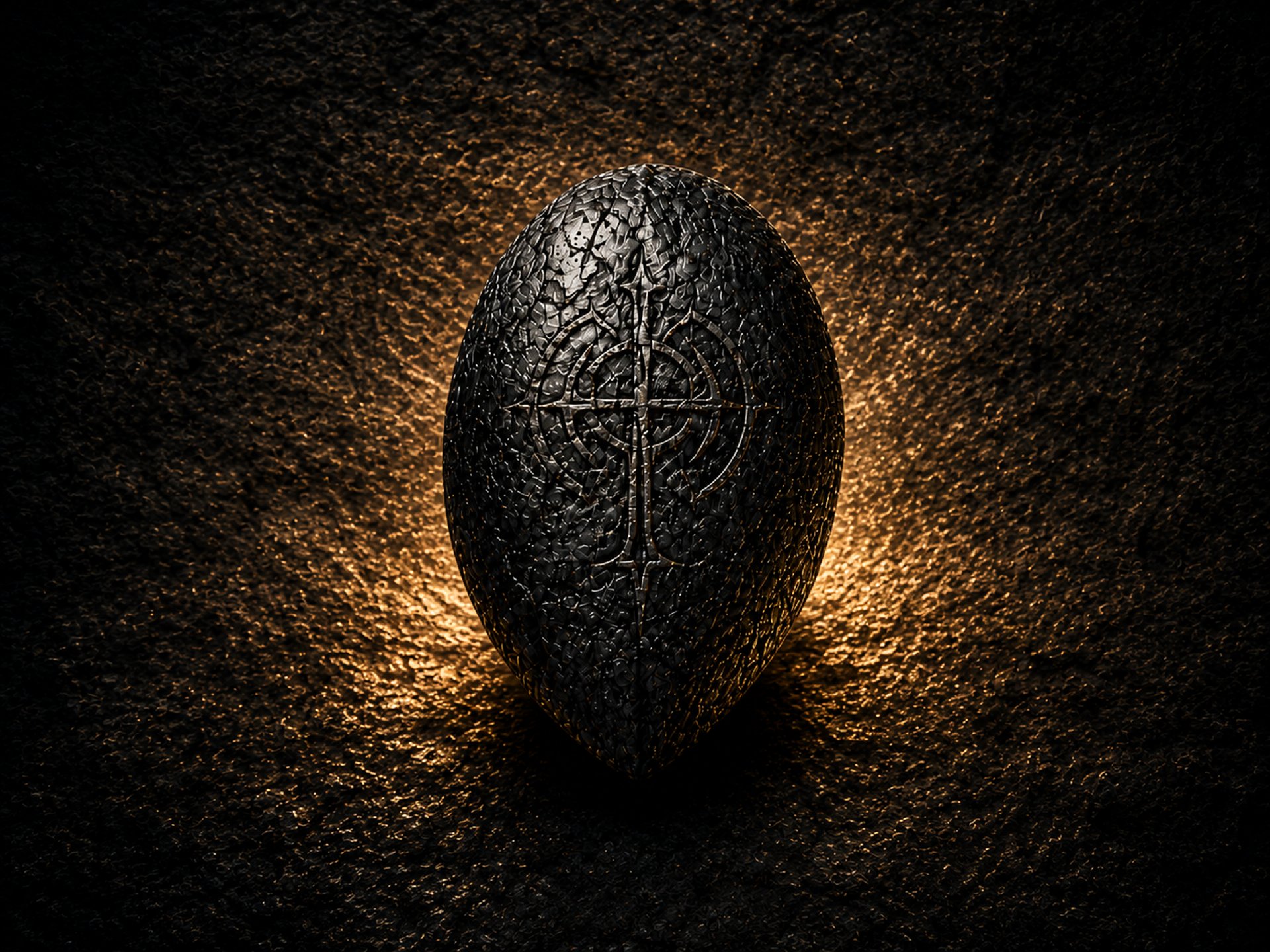
Chapter Three: The Mark
Unable to stop thinking about the mysterious black scale, Corin begins searching for answers and discovers a hidden symbol concealed within its surface. As his investigation leads him into forgotten records and ancient history, he uncovers clues that suggest the scale may be connected to a time long before the Dragon Houses and the world he thought he knew.
Three days passed.
Then four.
Then a week.
Ashvale went on as it always did. The mud from the storm dried and cracked and was replaced by the particular fine dust of late-season mountain air. Old Maret's cellar door was rehung and the hinges performed without complaint, which Bram noted with a single satisfied nod, as though the universe had behaved correctly and he had expected nothing less. A farmer brought in a broken harrow fitting. A family from the eastern slope needed a new set of pot hooks. A boy from the miller's house arrived with a bent wheel rim and a story about how the bending had happened that changed in three different ways between the telling and the retelling, until Bram sent him home with the repaired rim and a look that suggested he needn't return with any further stories.
Corin did his work. He kept the forge's rhythm. He ate his meals and slept his hours and answered when spoken to.
He could not stop thinking about the scale.
It lived wrapped in its cloth in the locked box under his cot — a small strongbox that had belonged to the previous apprentice and had come with the room and a key Corin kept on a cord around his neck. He had put the scale there the morning after Garran left, with the reasonable intention of leaving it alone until he decided what to do with it. He had opened the box six times the first day. Less, after that. But not much less.
He told himself he was being careful. He told himself he was waiting for something, though he couldn't have said what. He told himself Garran's warning was sensible and he was sensibly following it, and then he would finish dinner and sit on the edge of his cot and take the scale out again and hold it in both hands in the dark and think.
It was always warm.
That was the part he kept returning to. The warmth shouldn't have been there. He knew enough about materials — stone, metal, bone, hide — to know that nothing retained heat the way the scale did, without a source, without variation, without cooling overnight or warming from his hands. It was its own temperature, settled and constant, like a coal banked just perfectly. Not hot enough to be uncomfortable. Exactly warm enough to be impossible.
He turned it in the dark and tried to understand it.
He didn't, and then he put it away and slept, and then he woke up and it was in his thoughts before he was properly awake, which was how he knew it had become a problem of the particular kind he was worst at ignoring.
On the eighth day he found the mark.
He hadn't been looking for it. That was the thing he kept coming back to afterward — he'd had the scale for more than a week, had turned it and examined it in lamplight and morning light and held it against the forge glow, and the surface had always appeared the same. Absolute black, slightly lustrous, deep in a way that made light behave strangely against it. Nothing else.
He was cleaning up after the afternoon's work, banking the coals for the night, and the scale had slipped out of his pocket — it had become a habit to carry it, another habit he hadn't exactly decided on — and landed face-down on the workbench near the fire. When he picked it up, the surface was facing him directly, and the light from the coals was coming at it from a very low angle, barely grazing the edge of the scale, and the mark was suddenly there as though it had always been there and he had simply never looked correctly.
He went very still.
It was not on the surface. That was the first thing he understood. It was not carved or painted or etched in the conventional sense — not a marking applied from outside. It was within the material itself, embedded at some depth below the surface, visible only because of the way the firelight was catching the grain of the scale at this particular low angle. Like a watermark in paper. Like the pattern in folded steel that only shows itself when the light is right.
He crouched down until his eye was level with the workbench and looked at it straight on.
A symbol. Or the beginning of a symbol, or perhaps one part of a larger one — he couldn't be certain how much of it the scale contained. What he could see was a set of lines that curved and intersected with a deliberateness that was unmistakably intentional. Not decorative in the loose sense. Something more exact than that. The curves had a precision to them, the intersections were placed at specific angles, and the overall shape had the feeling of something that had been worked and reworked until it was exactly right.
He stared at it for a long time without moving.
Then the coals shifted and the angle of the light changed and it was gone. The surface was black again, uniform, giving nothing away.
He held the scale at every angle he could manage for the next quarter hour, trying to recover it. He got glimpses — a curve here, part of an intersection there — but never the whole thing again, not the way he'd seen it that first moment. He fetched a candle and tried that. Too direct. He tried the lamp at its lowest wick. Closer, but the flame was too steady and the angle wrong. He went outside with the scale and tried the last of the evening light and got nothing.
He came back in and sat at the workbench and thought about it.
The fire. Low and raking. That had been the condition. He rebuilt the coals carefully, not for heat but for light, banking them until they gave off a low broad glow without flame, and then he crouched and held the scale in front of them at the same angle and waited, adjusting by fractions, until the mark came back.
There it was.
He had no way to draw it. He didn't have paper and the light was wrong for moving away to find any. He fixed the shape in his mind instead, the way Bram had taught him to hold the image of a finished piece before you started working — build it whole in your head, so your hands know where they're going. He traced the curves and intersections with his attention, memorizing the proportions, the weight of each line, the overall shape of the thing.
Then the coals shifted again and it was gone.
He sat back.
It was not decorative. He was certain of that. Whatever the symbol was, it hadn't been put there to be beautiful. It had been put there to mean something.
He just didn't know what.
In the morning he took his breakfast and went to find the schoolmaster.
Old Perrin occupied a house near the center of the village with books enough to fill two rooms and a patience for questions that had made him indispensable to Ashvale for thirty years. He was retired in the technical sense, in that no one paid him anymore, but he still kept his books and still received visitors who came with genuine questions, which he distinguished reliably from visitors who came to be told what they already thought they knew.
Corin did not bring the scale. He'd thought about it and decided against. Instead, the night before, he'd taken the scale out again and spent another half hour in the low firelight until he'd seen the mark clearly enough and long enough to rough out a copy of it on a piece of scrap from the workbench — not perfect, but close. The lines were right. The intersections were right. He'd folded the scrap and brought that.
Perrin read a lot and moved slowly and made excellent tea. Corin accepted a cup and unfolded the scrap paper on the man's table and waited.
Perrin looked at it for a while. He put on his reading spectacles. He looked at it some more. He tilted the page at an angle, which made Corin think about the scale and the firelight, and tried not to show it.
"Where did you come across this?" Perrin asked.
"I'm not entirely sure. I'm trying to identify it first. Do you recognize it?"
Perrin made a considering sound. He rose — slowly, the way he did everything — and went to one of his shelves and came back with a thin volume of symbols and their origins used in heraldry and house crests. He turned pages in a deliberate way. He stopped on a few pages and compared. He moved on.
"Nothing exact," he said, after a while. "There's a partial resemblance to some of the older House crests — the ones that predate the standardization period. See this." He turned the book toward Corin and pointed to a crest that bore one curve vaguely similar to a piece of Corin's drawing. "The inner line there. But that's a coincidence of form, not origin, I'd say. The overall shape of yours is different in character."
"How so?"
"House crests have a particular grammar to them. Shapes chosen for legibility and status — you want a crest to be recognized at a distance, in a crowd, on a banner. This —" he tapped Corin's paper — "is working on a different principle. The lines are finer than they need to be for display. The intersections are too precise. It looks more like a glyph than a crest. Something meant to carry information rather than identity."
Corin looked at his own rough drawing with new attention. "Like a written character?"
"Or something related to one. But I don't recognize the language, and I know most of the scripts used in this region going back four or five centuries." He took off his spectacles and cleaned them. "Where did you say you found this?"
"I didn't," Corin said. "Not yet."
Perrin looked at him with the equanimity of a man who had heard evasive answers for thirty years and knew they almost always meant something interesting was happening. He handed the paper back. "If you find out, I'd be curious to hear it."
He tried two more people.
Dena, who kept the goods counter at the trading post and had an eye for markings and provenance that came from years of sorting imported wares. She looked at the paper, tilted her head, said it might be a maker's mark, said it might not be, said she'd never seen its exact like, said some of the southern craftsmen used symbols like this to indicate workshop origin but the ones she knew didn't have this particular shape.
And Wes, the shepherd's son, who had spent two years in the district seat before coming home and claimed to have visited the library there twice, which made him the most widely traveled person Corin could easily reach in a morning. Wes looked at the paper and said it looked like something he'd seen once in a book about the old mountain settlements, the communities that had existed in the high ranges before the Dragon Houses organized the lowland territories, but he wasn't sure, and when Corin pressed him he admitted the resemblance might be in his head.
By midafternoon Corin was back at the forge with three opinions and no answers.
"You're distracted," Bram said. It wasn't an accusation. It was the way Bram said most things — plainly and without particular feeling, because he trusted the plainness to carry what needed carrying.
"Sorry."
"Don't apologize. Just tell me what it is."
Corin looked at the hinge in his tongs. He'd overheated it. He could see from the color it had gone past the right moment and he'd missed it because he was thinking about something else. He put it back in the coals.
"I found something," he said. "I'm trying to understand what it is."
"The scale."
"Yes."
Bram was quiet for a moment. He was working a length of iron into a bracket, his attention on the work but some part of him, Corin knew, always available for the conversation running alongside it. "Garran said something to you. Before he left."
Not a question. Corin had expected this eventually. Bram missed very little.
"He said to keep it hidden."
"That's all?"
Corin pulled the hinge back out. Better now. He struck it. "He said someone might be looking for it."
The bracket came off the anvil and Bram turned it, checking the angle. He set it down and picked up his tongs again. "And you believe him."
"I believe he believed it."
Bram made the sound that meant he was thinking rather than responding. He went back to the bracket. Several strikes went by in the comfortable rhythm of the forge, the kind of silence that had room in it.
"Whatever you're looking for," Bram said eventually, "be careful where you look."
"I don't know where to look yet."
"Then be careful in the meantime."
The book was not where it was supposed to be.
Perrin's shelves were organized by a system that was entirely legible to Perrin and genuinely mysterious to everyone else — some combination of subject, age, and an association-logic that followed the pathways of his own interest. When Corin had left that morning, Perrin had mentioned, nearly as an afterthought, that he had somewhere a small volume on pre-Compact territorial markings — not symbols exactly, but boundary markers used by the mountain communities before the consolidation. He'd offered vaguely to find it, which Corin had taken for politeness.
But Perrin, when Corin returned after supper, had found it after all. He handed it over in the doorway with the apologetic air of a man who had looked at it himself and found it less useful than he'd hoped.
"Chapter four," he said. "Though I warn you, most of it is speculation. The pre-Compact records are thin."
Corin took it home and read chapter four by lamplight while the rest of the village settled into night.
Perrin was right that the records were thin. The author — a historian from the district seat writing perhaps two hundred years ago — noted repeatedly how little evidence survived from the period before the Dragon Houses consolidated power in the mountain regions, and how much of what did survive was fragmentary and difficult to date. The early settlements had kept their own records, but few had been preserved in the great libraries, and the historian offered a careful theory that some proportion had been lost to the general disorder of the consolidation period.
The word lost had a small annotation in Perrin's hand. A single word in the margin.
Destroyed?
Corin looked at that for a moment.
Then he turned the page and there it was.
Not the full mark. Not even close to the full mark. But in the lower corner of a page showing examples of boundary markers from the pre-Compact mountain settlements, there was a partial symbol — a fragment used as an example of the more elaborate markings occasionally found in the high ranges, whose origin the historian admitted was entirely unknown — and Corin recognized the curve of it. The angle of the inner line. The particular intersection that had no equivalent in the heraldry book.
It was the same family of symbol. He was certain of it the way he was certain of a color match when he was mixing a forge wash — not identical, not complete, but unmistakably related. The same grammar, as Perrin had called it.
The historian's note beneath it said only: Symbol of unknown origin, found carved into rock face, northern range. Believed predates recorded settlement. Purpose and meaning unknown. Not matched to any known House or organization. Possibly decorative.
Possibly decorative.
Corin looked at the partial symbol in the book, then took out his scrap paper and looked at his rough drawing of the mark from the scale.
They fit the way fragments fit. The partial symbol in the book was missing most of what the mark on the scale contained, but the piece that existed was consistent. Like finding a corner of a mosaic and recognizing the color of tile.
Someone had seen this symbol before. Someone had found it in the high ranges of the mountains, carved into stone, and had thought it possibly decorative and moved on.
But it wasn't decorative. He'd known that in Perrin's kitchen when the old schoolmaster had said it himself. It was a glyph. Something meant to carry information.
And it had been in the high ranges before any settlement. Before any Dragon House. Before the Compact that organized everything and named everything and established what the official history said had always been true.
The lamp guttered. He hadn't noticed the oil getting low.
He looked at the mark in the book and the mark on his paper and the darkness beyond the lamp's reach, and the question that settled into him was quiet and completely certain and not going anywhere.
What was old enough to predate all of it?
And why was its mark on the scale in his pocket?
Subscribe to our newsletter